
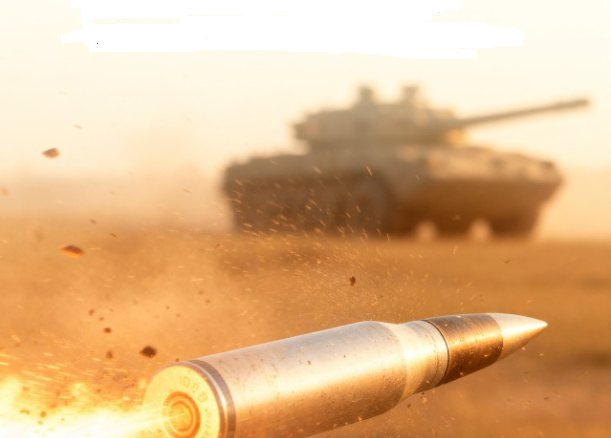
When we think of warfare, the first images that come to mind are explosions, firepower, and high-impact blasts. But modern conflict is no longer defined by explosions alone. Increasingly, it is shaped by something far less visible- the materials that make these systems work.
At the centre of this quiet transformation is a metal most people rarely think about: tungsten.
War Is No Longer Just About Explosions
Today’s battlefields demand precision. Targets are often heavily protected—buried underground, shielded by reinforced concrete, or armoured to withstand conventional attacks.
In such scenarios, simply exploding on impact isn’t enough.
This is where penetration-based systems come into play. Instead of relying purely on blast, these systems are designed to:
Break through defences first
- Deliver impact or detonation after penetration
- Maximize effectiveness with controlled force
We’ve already seen how modern warfare is evolving in regional conflicts, including threat from neighbouring countries, where systems like Pinaka multi-barrel rocket launcher and Akash surface-to-air missile reflect a growing emphasis on precision and performance.
But on a larger global scale, recent conflicts involving Iran, Israel, and the United States have further highlighted a critical reality:
Advanced materials- especially tungsten- are now central to how modern weapons function.
Tungsten in Today’s Conflicts
In recent high-intensity conflicts, tungsten has become a key component in several types of munitions- not because it explodes, but because of how it behaves under extreme conditions.
- Deep Penetration Weapons
Used against hardened or underground targets, these weapons rely on tungsten to:
- Stay intact at extremely high speeds
- Punch through layers of concrete, rock, or armour
- Deliver impact or detonation deep inside the target
Without a material like tungsten, such precision strikes would be far less effective.
- Missile Warheads & High-Speed Fragments
Many modern missiles use tungsten in the form of:
- Dense fragments or pellets
- High-speed projectiles released upon detonation
These fragments:
- Travel at extreme velocities
- Retain energy due to tungsten’s density
- Cause significant localized damage
This allows weapons to be more controlled and targeted, rather than relying on widespread blast damage.
- Controlled-Impact Systems
Some advanced munitions combine explosives with tungsten to:
- Focus energy in a specific direction
- Reduce unintended damage
- Increase efficiency against high-value targets
This reflects a broader shift toward precision over volume in modern warfare.
Why Tungsten Makes All This Possible
Tungsten’s role comes down to three simple advantages:
Weight (Density):
It hits harder because it’s heavier than most metals (twice the density of steel.)
- Strength (Hardness):
It doesn’t break or deform easily under impact.
- Heat Resistance:
It survives the extreme temperatures generated at high speeds.
In simple terms:
Tungsten allows weapons to go deeper, stay intact, and perform exactly as intended.
From Metal to Mission-Critical Performance
However, raw tungsten alone isn’t enough. Its effectiveness depends on how well it is:
- Processed
- Alloyed
- Engineered for specific applications
Achieving the right balance between strength and toughness is critical. Too brittle, and it fractures. Too soft, and it loses penetration power.
This is where companies specializing in advanced materials, such as Innomet Advanced Materials Ltd., play a crucial role. By focusing on precision metallurgy and application-driven development, they contribute to tungsten solutions that meet the demanding requirements of defence and other high-performance industries.
Their work ensures that tungsten is not just a raw material- but a reliable, high-performance component in real-world applications.
The Bigger Shift in Warfare
What we’re witnessing today is a shift:
From bigger explosions → to smarter impact
From volume of firepower → to quality of materials
Tungsten sits right at the centre of this transformation.
Final Thought
In modern warfare, success is no longer defined only by strategy or scale- it is increasingly defined by what things are made of.
And while it may not be visible on the surface, tungsten is quietly enabling some of the most critical capabilities on today’s battlefield.
Because sometimes, the most powerful force…
isn’t the explosion- it’s the material behind it.
By Siddharth Nair
#Tungsten #ModernWarfare #AdvancedMaterials #DefenceTechnology
#Innomet #InnometAdvanced #PrecisionEngineering