
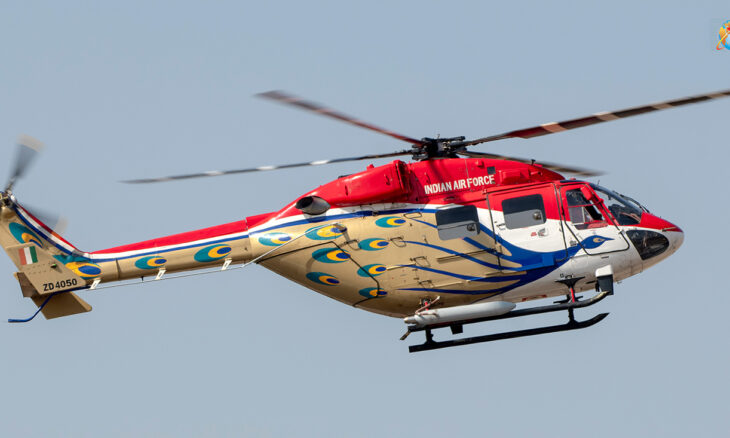
Every helicopter in the air has a vibration problem waiting to happen. Rotors spinning at several hundred revolutions per minute must be balanced to within grams. When they are not, bearings wear faster, structural joints fatigue, pilots tire quickly, and in the worst case, things break mid-flight. Keeping rotors in trim is a permanent line item on every operator’s maintenance bill and a core design challenge for every manufacturer.
The fix is surprisingly small- tiny weights added at precise points on the blade tips and hub. But rotor tips have almost no spare volume. You cannot bolt on a lump of steel. You need a material dense enough to pack the required mass into a cavity the size of a coin.
That material is tungsten heavy alloy. Roughly 1.7 times denser than lead and 2.4 times denser than steel, it is non-toxic, can be made non-magnetic for sensitive electronics, holds up at high temperatures, and unlike pure tungsten, machines cleanly. It has become the default across Sikorsky, Airbus Helicopters, Bell, Leonardo, and HAL. Every new helicopter program specifies it. Every overhaul replaces some of it.
For investors, the interesting part is not the chemistry. It is the structure of the market.
- China controls roughly 80% of global tungsten supply, and Western aerospace and defence buyers are actively diversifying away from Chinese sources.
- Lead is being pushed out of aerospace by environmental regulation, and tungsten alloy is the one-way substitute.
- The global helicopter fleet is growing- military modernization, offshore energy, emergency medical services, and urban air mobility all add aircraft faster than they retire them.
- Each balance weight is a low-volume, high-margin custom part. Specialty manufacturing, not commodity metal.
This is a niche with rising demand and a supply chain being actively redrawn.
But there is a filter. You cannot simply make tungsten parts and sell them to Airbus Helicopters. Aerospace supply is gated by AS 9100D- the international quality standard every Tier 1 prime demands before qualifying a supplier. Most specialty metal firms never cross that audit. Those who do sit inside a much smaller and more valuable room.
It is worth noting, in that context, that a small Hyderabad-based specialty manufacturer, Innomet Advanced Materials Ltd, earned AS 9100D certification in FY26 and already exports tungsten heavy alloy components to Israel and USA.
The broader picture matters more than any single name. Helicopters are not going out of fashion. Their rotors will keep needing precisely balanced weights. Those weights will keep being made from tungsten heavy alloy. And the supply chain for that alloy is shifting away from China toward India and other allied manufacturing hubs.
Somebody is going to absorb that business. Those looking for real structural themes- not the ones in every headline- could do worse than look at where the non-negotiable materials of modern aviation are quietly being made.
By Siddharth Nair