
Walk into any modern Indian home and look at the floor. Chances are, the tiles came from Morbi in Gujarat – the cluster that produces nearly 70% of India’s ceramic tiles and exports to over a hundred countries. What most buyers do not see is the constant pressure on tile manufacturers to fire faster, use less gas, and still produce a stronger, flatter, more uniform tile.
One mineral has quietly become central to solving that problem: Wollastonite.
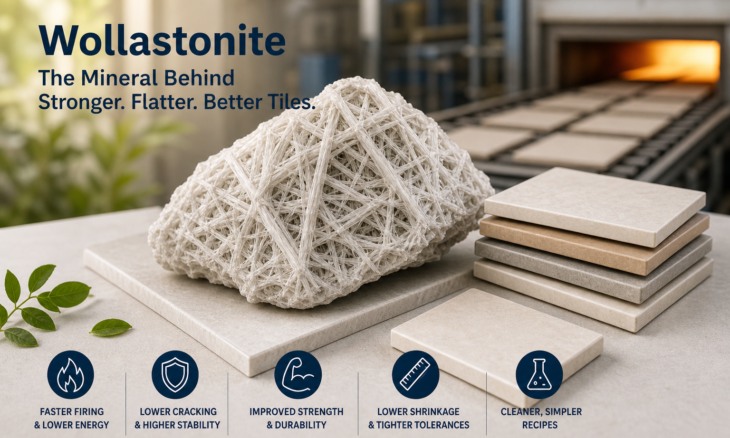
Wollastonite is a calcium silicate mineral with a distinctive needle-like crystal structure. That structure, combined with its chemistry, makes it one of the most useful functional minerals in modern ceramic body and glaze formulations.
Functional Role of Wollastonite in Ceramic Bodies
Unlike traditional fillers, Wollastonite contributes to multiple performance properties at the same time, which is why it has steadily replaced or supplemented older raw materials in many tile and sanitaryware recipes.
- Faster Firing and Lower Energy Cost
The acicular structure and low loss on ignition of Wollastonite allow ceramic bodies to be fired in shorter cycles.
- Reduces the firing time in roller-hearth kilns
- Lowers the peak firing temperature in many formulations
- Cuts fuel consumption per square meter of tile
- Increases kiln throughput without adding capacity
For a tile plant running multiple kilns 24 hours a day, even a small reduction in firing cycle translates to a meaningful drop in gas bills.
- Lower Thermal Expansion and Reduced Cracking
Wollastonite has a very low coefficient of thermal expansion compared to most ceramic raw materials.
- Reduces stress between the body and the glaze during cooling
- Lowers the risk of crazing, especially in single-fired wall tiles
- Improves dimensional stability through repeated thermal cycles
- Helps maintain tile flatness during firing
This is one of the main reasons wall tile manufacturers value Wollastonite so highly.
- Improved Mechanical Strength
The needle-shaped particles act almost like internal reinforcement inside the fired ceramic body.
- Increases modulus of rupture (a key strength measure)
- Improves resistance to cracking under load
- Supports the production of thinner, lighter tiles without losing strength
- Helps reduce breakage during cutting, packing, and transport
For exporters shipping tiles across long distances, this directly affects bottom-line losses.
- Lower Shrinkage and Better Dimensional Control
Ceramic bodies shrink during drying and firing. Excess shrinkage causes warping, size variation, and rejects.
- Wollastonite reduces both drying and firing shrinkage
- Produces tiles with tighter size tolerances
- Lowers reject rates from out-of-spec dimensions
- Supports calibrated, rectified tile production
Tighter tolerances mean fewer downgrades and better realisation per square meter.
What Differentiates Wollastonite as a Ceramic Raw Material?
The advantage of Wollastonite is not one single property – it is the combination.
- High aspect ratio crystals that reinforce the ceramic body
- Low loss on ignition (typically below 2%) which means less gas given off during firing
- Calcium oxide content that acts as a flux and helps lower firing temperatures
- Free silica content that supports glaze compatibility
Compared to using a combination of limestone, talc, and feldspar to achieve similar results, Wollastonite offers the same outcomes through a single, cleaner raw material. This simplifies recipe management for ceramic plants.
Application Insight: Wall Tiles, Sanitaryware, and Frits
Wollastonite plays slightly different roles across ceramic segments.
- Wall tiles: the dominant use, where fast firing and crazing resistance matter most
- Floor tiles: used in selected formulations to improve strength and reduce warpage
- Sanitaryware: improves whiteness, lowers firing temperature, and reduces cracking in complex shapes
- Glazes and frits: acts as a source of calcium oxide and helps modify melting behaviour
- Technical ceramics: used where low thermal expansion and dielectric properties are required
For Indian ceramic clusters under pressure to compete with Chinese imports on cost and Vietnamese exporters on quality, formulation efficiency is no longer optional.
Material Innovation and Industry Ecosystem
Ceramic plants are highly sensitive to variation in raw materials. A small change in particle size, brightness, or chemistry can disrupt entire production batches.
Companies such as 20 Microns Ltd play a meaningful role here by supplying engineered Wollastonite grades with controlled particle size, consistent chemistry, and predictable behaviour in the kiln.
This consistency matters because:
- Ceramic recipes are fine-tuned to specific raw material profiles
- Variation in one input forces costly adjustments across the entire process
- Reliable supply reduces dependence on imported alternatives
As Indian ceramic manufacturers move toward higher-value products such as large-format slabs and rectified porcelain tiles, the demand for engineered functional minerals like Wollastonite will continue to grow.
Conclusion: A Functional Mineral Built for a Cost-Conscious Industry
Wollastonite is not a glamorous mineral. It does not get headlines like lithium or graphite. But inside the ceramic industry, it solves several problems at once – energy cost, mechanical strength, dimensional stability, and glaze compatibility.
By contributing to:
- Faster firing cycles
- Stronger, flatter tiles
- Lower reject rates
- Cleaner, simpler recipes
…Wollastonite quietly supports the competitiveness of one of India’s most globally relevant manufacturing clusters.
In ceramics, the smallest changes in raw material selection often decide who wins on margin. Wollastonite is one of those changes.
By Siddharth Nair