
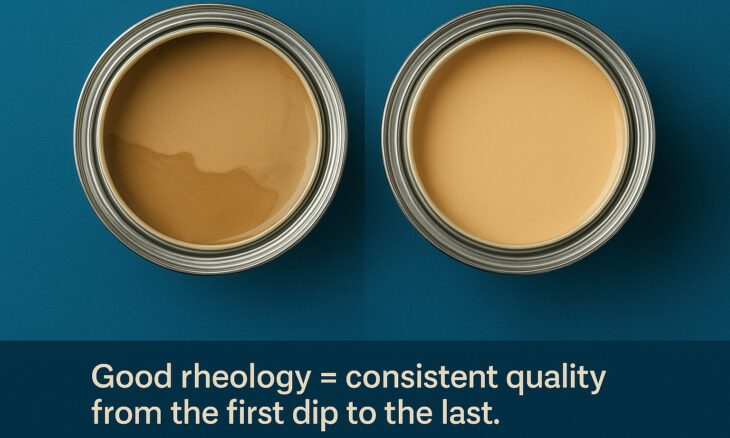
How flow behaviour determines whether a coating performs — in the can, during application, and throughout its service life
A can of paint looks simple. What happens inside it before it ever reaches a wall, a ship’s hull, or a car body is not. How that liquid flows, thickens, settles, and levels out is governed by rheology — and getting it wrong is one of the most common —and costly—reasons a coating fails.
What rheology actually controls
Rheology is the science of how materials flow and deform under applied stress, making it one of the most critical parameters governing coating performance.. In coatings, poor rheology control manifests in several practical problems: pigments settling to the bottom of the can during storage, paint sagging on vertical surfaces after application, uneven film thickness once it dries, and reduced storage stability and shelf life before the product is even used. None of these are cosmetic problems — they lead to rejected batches, rework, and coatings that fail in the field.
Thixotropy: flow on demand
Formulators solve this with rheology modifiers — additives that give a coating exactly the behaviour it needs at each stage. An ideal rheology modifier provides a coating with high low-shear viscosity for excellent pigment suspension while simultaneously allowing low high-shear viscosity during stirring, brushing, rolling, or spraying. Once the shear is removed, the viscosity rapidly rebuilds to prevent sagging and improve film build.
Organoclay additives in practice
Organoclay-based rheology additives are engineered to create a three-dimensional network within solvent-based coatings, producing controlled thixotropic behaviour. This network efficiently suspends pigments and extenders, improves storage stability, prevents sedimentation, and enhances sag resistance without compromising application properties. In practical terms, that delivers:
- Superior rheology control and viscosity build-up, so the coating behaves predictably at every stage
- Outstanding anti-settling performance, preventing sagging and pigment settling over extended storage
- Uniform pigment dispersion, for consistent colour and finish batch after batch
- Exceptional sag resistance, especially on vertical or overhead surfaces
- Smooth film levelling and surface finish
- High-clarity gel formation, producing light-coloured gels with excellent transparency — important where the additive itself must stay invisible in the finish
- Simplified processing, with no pre-gel step required, removing a stage from production
- Compatibility with solvent-based systems, optimised for low-to-medium polarity paints
- Improved storage stability, extending shelf life without loss of performance
Why the “no pre-gel” point matters
Many organoclay rheology additives require a separate activation step — pre-gelling with a polar activator — before they can go into the batch. Eliminating this activation step reduces production time, lowers processing cost, minimizes operator dependency, and improves manufacturing consistency. It is the kind of detail that matters to a plant manager more than a marketing adjective does.
Why this matters for formulators
The true value of a rheology additive is not defined by a single property but by its ability to simultaneously deliver suspension stability, sag resistance, application ease, and long-term storage stability. A formulation is only successful when all these performance attributes remain consistent from laboratory development to full-scale production.
The bigger picture
Rheology is invisible to the end user, but it decides whether a coating performs the way it was designed to. It gives coating manufacturers a reliable way to keep that flow behaviour under control, across a wide span of coating types, without adding steps to the process.
A coating’s performance is determined long before the first brushstroke or spray pass. Behind every durable, defect-free coating lies one invisible science—rheology. Mastering rheology means mastering coating performance.
#Rheology #Coatings #CoatingTechnology #CoatingsIndustry #RheologyModifiers #Organoclay #Thixotropy #PaintsAndCoatings #CoatingPerformance #PaintTechnology #Formulation #CoatingFormulation #PigmentDispersion #SagResistance #AntiSettling #ViscosityControl #SurfaceFinish #IndustrialCoatings #AdvancedMaterials #SpecialtyChemicals #Additives #CoatingInnovation #ManufacturingExcellence #SolventBasedCoatings #MaterialScience
#20Microns #20MicronsNano