
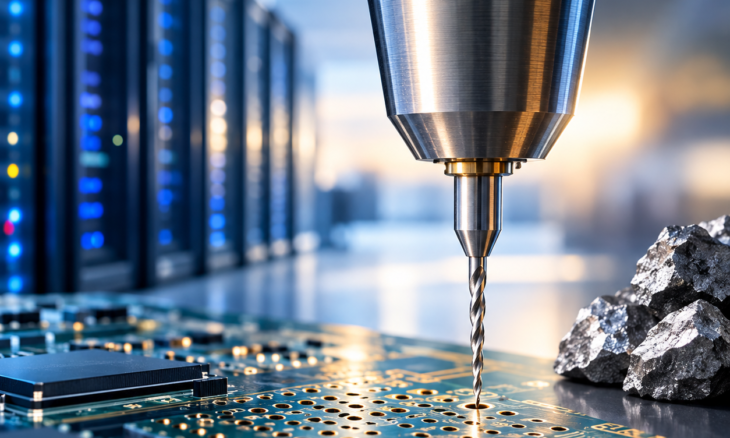
When people talk about what’s powering the AI revolution, the conversation usually stops at GPUs, data centres and power grids. Almost nobody talks about tungsten. And yet, tucked inside every AI server sits a component made from this dense, unglamorous metal — a tungsten carbide micro-drill bit so small it barely registers, quietly punching thousands of microscopic holes into the circuit board that brings that server’s chips to life.
It turns out this humble tool — and the metal it’s made from — has become one of the more interesting supply-chain stories of the AI era.
Why AI servers need a different kind of drill
Ordinary circuit boards are relatively simple to manufacture. AI server boards are not. To handle the sheer density of chips, memory and high-speed interconnects that GPUs demand, these boards are built with far more layers, thicker copper and harder composite materials than a typical PCB. Drilling clean, precise holes through that stack — sometimes smaller than a strand of hair in diameter — requires a drill bit that can survive extreme heat, friction and pressure without snapping or dulling.
Tungsten carbide is the only material hard enough and stable enough to do this reliably at scale. As boards get thicker and more complex, the drills wear out faster — so every new-generation AI server doesn’t just need better drills, it needs more of them per board.
A quiet bottleneck emerges
Here’s where it gets interesting: at the precision AI-grade boards demand, only a small handful of manufacturers worldwide can produce these micro-drills reliably. Two Asian toolmakers dominate the market, and industry trackers report their combined capacity utilisation now sits above 90% — effectively sold out. Global demand for these drill bits has been estimated at well over $800 million and rising, and analysts expect the shortage to persist through 2026 even after recent capacity expansions, simply because building new precision-tooling capacity takes years, not months.
What makes this bottleneck particularly stubborn is that it doesn’t end with the drill bit maker. Behind every micro-drill is a supply chain of tungsten raw material, tungsten carbide powder and rod stock — and reports from the region suggest that high-grade tungsten carbide powder itself is now running tight internationally, even as demand for it accelerates. In other words, the AI boom isn’t just consuming more chips and more electricity — it’s quietly consuming more tungsten, at every stage from raw powder to finished tool.
Why this matters beyond electronics
This is a useful reminder that the AI buildout’s appetite doesn’t stop at silicon. It radiates backward through dozens of unglamorous material supply chains — copper for wiring, rare earths for magnets, and now, tungsten for the tools that make the boards themselves possible. As global AI infrastructure spending continues to scale through this decade, demand pressure on tungsten and tungsten-based materials looks set to broaden — not just from defence and industrial applications, where tungsten has traditionally been indispensable, but increasingly from the technology sector itself.
For companies operating across the tungsten value chain — from powder production to specialised, high-value tungsten components — this emerging demand vector is one worth watching closely. The AI story, it turns out, runs through some very small, very hard holes.
#TungstenDemand #AIInfrastructure #SupplyChainBottleneck
#SemiconductorSupplyChain #CriticalMinerals #PCBManufacturing #AIHardware #Innomet #Advancedmaterials #InnometAdvanced #Tungsten #THA