
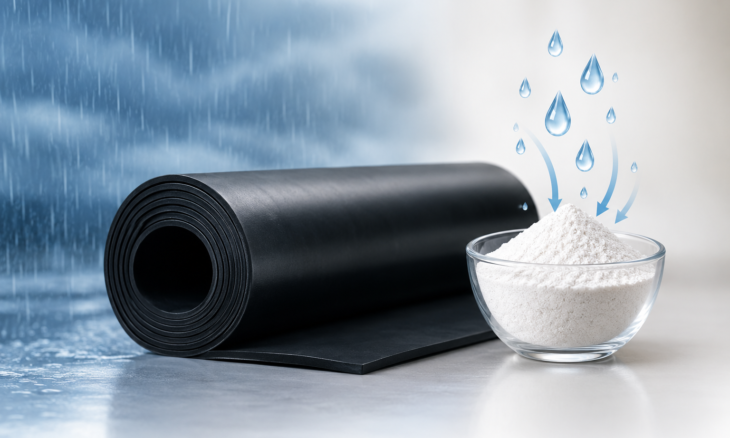
A high-purity, surface-treated calcium oxide desiccant engineered for demanding rubber compounding applications
Most rubber manufacturers focus on optimizing polymers, fillers, accelerators, and curing systems—but often overlook one of the biggest hidden variables: moisture.
Why Moisture is the Hidden Enemy of Rubber Processing
Rubber compounds absorb moisture from multiple sources, including hygroscopic fillers, ambient humidity during storage, recycled materials, and condensation on cold raw materials – hygroscopic fillers, humid air during storage, even condensation on cold raw material. During vulcanization, that trapped water turns to steam. and the result shows up as defects:
- Blisters and pinholes on the product surface
- Porosity inside the part, weakening it structurally
- Poor dispersion of fillers, hurting consistency
- Longer cure times, slowing down production
- Higher rejection rates, which is where all of this ends up hitting the bottom line
Each rejected batch is wasted material, wasted machine time, and a delayed delivery. Moisture doesn’t announce itself; it just quietly raises your cost per good part.
The monsoon multiplier
In India, this problem has a season. From June to September, relative humidity across most manufacturing belts stays high for weeks at a stretch. Fillers absorb moisture faster, particularly precipitated silica, clay, calcium silicate, carbon black with surface oxidation, and recycled fillers and processes that ran clean in March suddenly start throwing defects in July. Many plants simply accept higher rejection rates during monsoon as a cost of doing business. They shouldn’t have to.
The solution: a purpose-built desiccant
Material science companies like 20 Microns and others offer a high-purity, surface-treated calcium oxide desiccant designed specifically for rubber compounding. The principle is simple: Calcium oxide chemically reacts with water to form stable calcium hydroxide, permanently removing moisture from the compound before vulcanization. Surface modification significantly improves compatibility with the rubber matrix, allowing faster dispersion and minimizing localized agglomeration.
In practical terms, compounders get:
- Rapid moisture absorption — water is captured before vulcanization, not after it causes damage
- Better dispersion — uniform mixing throughout the compound
- Stable processing — consistent behaviour batch after batch, season after season
- Faster cure — no moisture interference means the cure cycle runs as designed
- Consistent product quality — fewer surprises, lower rejection
The result is a process that behaves the same in peak monsoon as it does in dry winter — which is exactly what a production planner wants.
Where it fits
This desiccant is built for demanding rubber applications where surface finish and structural integrity cannot be compromised:
- EPDM profiles and weather seals — where a single blister ruins a sealing surface
- Continuous vulcanization lines (UHF, LCM, microwave) — where moisture defects appear instantly at line speed and scrap adds up fast
- Hoses, belts and tubing — where porosity means pressure and flex failures
- Cable compounds — where voids compromise insulation performance
- Automotive sealing systems, anti-vibration components, hoses, mounts, and molded rubber parts
Continuous vulcanization deserves special mention: because the process is fast and uninterrupted, there is no opportunity to correct moisture issues mid-run. A desiccant in the compound is effectively insurance for the entire line.
For modern rubber manufacturers, moisture control is no longer an option—it is a process reliability strategy.
The simple economics
Although added at a relatively low dosage, a calcium oxide desiccant significantly reduces the hidden manufacturing costs associated with scrap, rework, machine downtime, delayed dispatches, and customer complaints. For plants that see rejection rates climb every monsoon, the payback logic is straightforward.
Among leading material science companies, 20 Microns has engineered a high-performance surface-treated calcium oxide desiccant specifically for modern rubber compounding applications.
Moisture will always be in the air. It doesn’t have to be in your rubber.
#RubberCompounding #MonsoonMoisture #CalciumOxide #RubberManufacturing #DefectFreeRubber #20microns #20micronsnano #Materialscience