
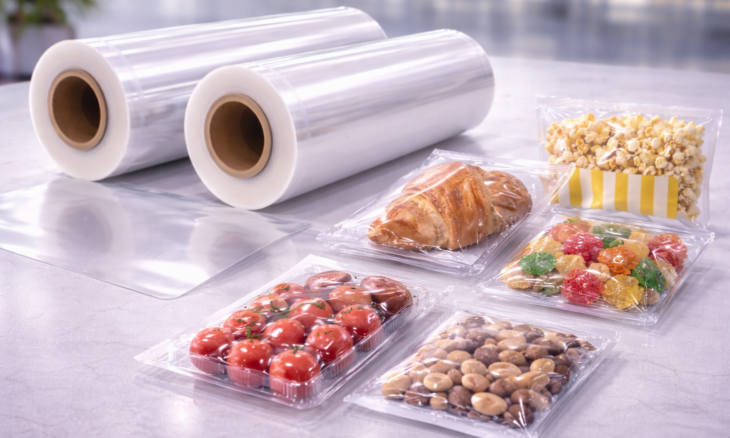
If you’ve ever pulled apart a plastic bag and felt it resisting you, or watched a packaging line struggle because film layers cling to each other, you’ve encountered blocking– one of the most common and costly headaches in the plastics processing industry.
The good news? It’s entirely preventable.
What Is Blocking?
Blocking is the term for what happens when two layers of polyethylene or polypropylene film stick together. At a microscopic level, smooth plastic surfaces are almost perfectly flat- and when flat surfaces are pressed against each other (from winding, stacking, or heat), they create a kind of molecular adhesion. The result: film that won’t separate cleanly, bags that won’t open easily, and production lines that slow down or jam.
It sounds like a minor inconvenience, but in high-speed packaging or agricultural film applications, blocking can mean wasted material, damaged products, and significant downtime.
Enter Anti-Block Additives
Anti-block additives are functional mineral-based ingredients incorporated into plastic film during manufacturing. Their job is simple but elegant: they create microscopic surface roughness on the film, so that when two layers meet, they touch only at tiny raised points rather than across their entire surface area.
Think of it like two pieces of sandpaper placed face to face versus two sheets of glass. The textured surfaces barely cling to each other- they’re easy to pull apart.
These additives are typically inorganic minerals- diatomaceous earth (DE), talc, feldspar, or calcined kaolin- precisely processed to a specific particle size and shape. The irregular geometry of the particles is key: they protrude just enough from the film surface to create those tiny separation points, without compromising the film’s appearance or mechanical strength.
How Are They Used?
Anti-block additives are commonly used at concentrations of 0.2–0.5 wt.% relative to the polymer resin. The required dosage is formulation-dependent and can be influenced by the nature and concentration of fillers, as well as the characteristics of the polymer substrate. Consequently, higher additive loadings may be necessary in highly filled systems to maintain adequate anti-blocking performance. They work across all major polyolefin film types: LLDPE, HDPE, metallocene PE, and PP.
Getting the particle size right matters enormously. Too coarse, and the additives can cause haze or surface defects. Too fine, and they lose their effectiveness. The right grade delivers anti-blocking performance while maintaining the film’s:
- Clarity– important for display or retail packaging
- Low haze– especially critical for food wrap or overwrap films
- Gloss– for packaging that needs to look premium
- Strength– no compromise on tear or tensile properties
What Makes a Good Anti-Block Additive?
Beyond particle size, the best anti-block additives share a few defining characteristics: tight particle size distribution (consistency batch to batch), a refractive index close to that of the polymer matrix (which minimises optical impact), and a bright white colour that doesn’t affect the film’s appearance.
They should also disperse cleanly and uniformly in the melt- uneven dispersion leads to hot spots, streaks, or gels in the final film.
What sets it apart is the combination of anti-blocking performance with low haze and high clarity- properties that are often in tension with each other. For film producers who can’t afford to sacrifice aesthetics for functionality, this balance is significant. 20 Microns, India’s largest producer of ultrafine industrial minerals. are among the leaders in the anti-block additive segment.
The product is usually available in grades suited for LLDPE, metallocene PE, and PP film lines, with minimum effective loading- which also helps control formulation costs.
The Bottom Line
Anti-block additives may constitute only a small portion of a film formulation, but they play a critical role in ensuring smooth processing, operational efficiency, and end-product quality. As packaging, agricultural, and specialty film applications continue to evolve, demand is increasingly shifting toward high-performance mineral additives that deliver functionality without compromising clarity or aesthetics. For manufacturers with expertise in ultrafine mineral processing and application-specific formulations, this represents a niche but growing value-added opportunity within the broader plastics additives market.
By Siddharth Nair
#PlasticFilms #PackagingIndustry #PolymerAdditives #AntiBlockAdditives
#MineralProcessing #PlasticsManufacturing #IndustrialMinerals #20Microns #20MicronsNano #Specialityminerals